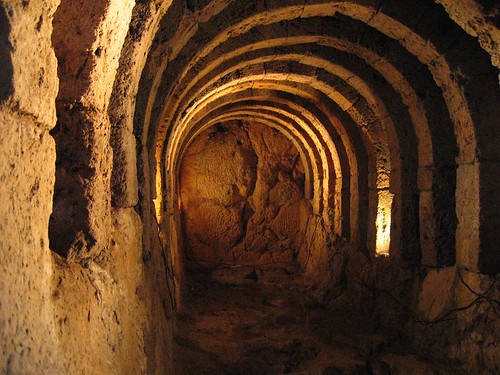
 The most famous ancient Greek world Nekromanteion, the Oracle of the Dead, lies near the northwest shores of the Lake Acherousian, where Acheron and Kokytos, the Rivers of Hades, meet
 . Ancient literary sources describe the Acherousian Lake as the place where the dead began their descent to Hades.
The Nekromanteion attracted people wishing to meet the souls of the dead, as these were able to foresee the future after having left their body. (Spookkyy!!!)
References to this site are found in Homer’s Odyssey, when Circe advises Ulysses to meet Teiresias, in the underworld in order to receive an oracle for his return to Ithaka. Homer also gives a vivid account of the mortal Odysseus's descent to Hades. The resemblance between the setting described by Homer and the site of the nekromanteion  is astonishing, a fact also noted almost one thousand years later by Pausanias, who argues that Homer had visited this area.
 is astonishing, a fact also noted almost one thousand years later by Pausanias, who argues that Homer had visited this area.
Also interesting monument near the site is the chapel with the Black Madonna Painting. For more details click here
Other Links:
Photographs of Nekromanteion;
Map of Nekromanteion;
Other Links:
Photographs of Nekromanteion;
Map of Nekromanteion;



 Posts
Posts