Showing posts with label Peloponnese. Show all posts

Tuesday, 29 September 2009

Kalavrita - A journey through Vouraikos Gorge, The Cave of the Lakes, Ski Tracks & Greek War Monuments - (Peloponnese, Greece)

You can drive all the way up, but it is highly recommended to take the Vouraikos River, Funicular Railway from the coastal town of Diakofto all the way up to Kalavrita.

Built in 1885 by the Italians, the train traverses around 20 Kms on the narrow gauge tracks through a fine gorge, following the stream bed of River Vouriakos, winds up into the mountains through tunnels, past water-falls, along cliffs and through forests of pine and oleander. The hour long journey is one of the most spectacular train rides in the world. If you plan to take this wonderful journey, it is recommended by the Lonely Planet Guide to get first class tickets as those seats have the best view.

There are numerous Hiking Trails in the area. If you want to hike up the challenging Vouraikos Gorge, then you can alight at the small village of Zachlorou. An hour walk from the village of Zachlorou is the spectacular site of The Holy Monastery of Mega Spileo (“Grand Cave”). Built in a giant cave in 326 AD, it is full of beautiful frescoes, mosaic floors and other treasures. You will also be rewarded with a fantastic view of Mount Chelmos, Mount Petruki and the Ladopotamos River. Many people walk down through the gorge to Diakofto.

Post Zachlorou you arrive in Kalavrita.

Of importance are the following monuments:

Around Kalavryta
Kalavrita Ski Center – It is located 14 kms from Kalavrita, complete with modern facilities and recognized as one of the best in Greece.

If you are interested in Greek mythology, an excursion to The Waters of Styx and the Mavroneri Waterfall can be made. This is where Achilles was baptized and achieved immortality, (with the exception of the spot on his heel where his mother held him).

Another place of steeped in mythological references and of great natural beauty is the River Ladonas – Lake Ladonas. Ladonas is one of Ancient Greece’s mythical rivers.

The Holy Monastery of the Assumption of the Virgin of Makellaria – famous for its wonder-working icon of the Virgin. It is a work of art from the Byzantine period, admired by all for its particular feature of giving the impression that wherever you stand the Virgin’s eyes follow you.

The Holy Chapel of Panagia Plataniotissa - the small chapel is tucked inside the hollow of a large plane tree, which can hold as many as 20 people.

There are also several archaeological sites scattered throughout the hills and mountains around Kalavrita including the Archaeological Site of the Ancient City of Klitor; Archaeological Site Of Ano Lousoi; Pafsania’s Vine Branch

The Cave of the Lakes – it is located on the way from Kalavrita to Klitoria at an altitude of 827m.The cave is endowed with a unique geomorphologic character not found anywhere else in the world. 13 lakes are arranged in a cascading format at three different levels inside the cave. The cave is fed by snow melts which are canalised through swallow-holes and underground natural channels. Although the existence of the cave has been known since ancient times, its second level was not discovered until 1964. In the lower level (inaccessible) were found human and animal fossils of Paleontological importance, as well as remnants of pottery dating back to the Neolithic and the early Helladic period. In 1981, the cave was opened to the public. The cave covers an area of 20,000 square meters, of which only 1,980 have been explored and 350 have been arranged for tourist visits. The visitor enters the cave through an artificial tunnel which leads directly to the second floor. There is a metal walkway that follows the string of cascading lakes and climbs through the subterranean passageway complete with magnificent multicoloured stalactites and stalagmites. In winter when the snow melts, the cave is transformed into a subterranean river with natural waterfalls. In the summer months, part of the cave dries up revealing a lace-work of stone-basins and dams of up to 4 m in height. The rest of the cave retains water permanently throughout the year in 13 picturesque lakes.Tours are taken through the cave every half hour or so and the guide speaks in English and Greek. The cave is open to the public all year round; facilities include a waiting room and a tourist kiosk. You are not allowed to take pictures, but the postcards they sell at the kiosk are good enough.

Some interesting links on Kalavrita are: Off-Road Outings By Jeep; en.wikipedia.org/Kalavryta; http://www.kalavrita.gr/DynSITE/?lang=en; Matt Barrett's - Kalavrita

How to Reach

  • By Car: If you drive from Athens, you take the national road that goes south to Corinth and then you follow the signs for Patra. You turn for Kalavrita in the conjunction of Diakofto. The trip will take about 3 hours.

  • By Bus: There are several buses that leave daily from Athens to Kalavryta. More information can be obtained at http://www.ktel.org/. There are also special buses during winter for skiers. The buses live early in the morning from Kifissia, Kalimarmaro, Neo Psichiko and Palaio Faliro.

  • By Train: There is also a rail service to Kalavrita. You go by the regular train to Diakofto and then you change and take the funicular train up till Kalavrita town. The trip from Diakofto to Kalavrita takes almost an hour. It is considered as an amazing trip especially during spring. You will find more information at http://www.ose.gr/

Accommodation: www.kalavrita-hotels.gr/; /www.web-greece.gr/kalavrita; http://www.greekhotels.gr/peloponnese_hotels/ahaia_hotels/kalavryta_hotels.asp;

Olympia - On the Trail of the Olympic Blaze (Peloponnese, Greece)

The fire of our Olympic Games were first lit here (if not literally). It was the site of the Olympic Games celebrated every four years by the ancient Greeks. The location of the sanctuary of Olympia in a lush region irrigated by two rivers, the Alpheus and the Cladeus, led Pindar to call it the kallistos topos (most beautiful place) of Greece. It was not a town, but only a sanctuary with buildings associated with games and the worship of the gods.

Today the archaeological site is accessed from the north side and runs along the length of the Gymnasium which has not yet been entirely excavated. The sacred precinct was situated at the foot of the Hill of Cronus, bind the site on the north. Outside the sacred precinct were the athletic facilities and visitors accommodations (guest houses baths etc). The southeast section of the site that contained the Hippodrome has been washed away.

More information on History of Olympia click: http://www.olympia-greece.org/history.html
The most important buildings in the site today are:
Prytaneion of Olympia: one of the oldest and most important buildings, it was the administrative centre of the sanctuary's political life and of the Olympic Games. It was the seat of the magistrates, the high officials who oversaw the sacrifices performed monthly to honour the gods. The Prytaneion occupied the north-west corner of the sacred enclosure, directly opposite the gymnasium.
Palaestra of Olympia: It is situated west of the Altis enclosure, near the Kladeos River. Built in the third century BC as part of the gymnasium complex, it was used to practice boxing, wrestling and jumping. At its centre was an open court, forty one metres square, surrounded by a Doric colonnade of 72 columns and laid with fine sand on which the athletes trained.
Temple of Ξ—era at Olympia: one of the oldest monumental temples in Greece, stands in the north-west corner of the sacred precinct of the Altis, on the south slopes of Kronios hilll. It was dedicated to the Olympian sanctuary by the inhabitants of Skillous, an ancient city of Eleia.

Temple of Zeus at Olympia: standing in the centre, is the largest temple in the Peloponnese, the most important building in the Altis. It was built by the Eleans from the spoils of the Triphylian war and dedicated to Zeus. In this temple was a statue of Zeus made of ivory and gold, the masterpiece of the Athenian sculptor Phidias.
Workshop of Pheidias: West of the sacred enclosure, directly opposite the temple of Zeus, was the workshop of Pheidias where the great sculptor crafted the gigantic statue of Zeus, listed as one of the Seven Wonders of the Ancient World. The building was erected in the second half of the fifth century, when Pheidias, after completing the sculptures for the Athenian Acropolis, went to Olympia to work on the statue of Zeus. Excavation finds and potteries date it precisely to 430-420 BC.

Leonidaion: situated at the south-west corner of the sanctuary, outside the sacred precinct of the Altis, was a large and luxurious hostel for distinguished visitors to the Olympic Games. It was built in approximately 330 BC and was remodelled twice during Roman times. A dedicatory inscription partially preserved on the epistyle of the outer Ionic stoa records that the building was erected by Leonidas son of Leotas from Naxos, who was both architect and benefactor.
Ancient stadium of Olympia: Situated east of the sacred Altis enclosure, this was where the ancient Olympic Games and the Heraia, the women's games in honour of Hera, were held. Before the sixth century BC the running events were held on a flat area along the treasuries' terrace, east of the great altar of Zeus. A first stadium (Stadium I) was formed in the Archaic period (mid sixth century BC) by levelling the area south of the Kronios hill inside the Altis.
More information on the Archaeological Site click: http://www.olympia-greece.org/site.html
The French began excavations here in 1829. German explorations of 1875-81 threw much light upon the plans of the buildings; they were resumed in 1936, 1952, and 1960-61. Important finds included sculptures from the Temple of Zeus, the Nike of Paeonius, the Hermes of Praxiteles and many bronzes. In total 14,000 objects were recorded.

The finds are displayed in the Archaeological Museum of Olympia, one of the most important museums in Greece. The museum's permanent exhibition contains finds from the excavations in the sacred precinct of the Altis dating from prehistoric times to the Early Christian period. Among the many precious exhibits the sculpture collection, for which the museum is most famous, the bronze collection, the richest collection of its type in the world, and the large terracotta collection, are especially noteworthy. The most important artefacts on display includes:
  • The sculptured ornaments from the Temple of Zeus
  • Hermes of Praxiteles
  • Nike of Paionios
  • Zeus and Ganymedes
  • Bronze breast-plate with incised decoration.
  • The Helmet of Miltiades
  • Bronze battering-ram
  • Bronze horse

More information on the Archaeological Museum of Olympia click: http://www.olympia-greece.org/museum.html

How to Reach:

  • From Athens by Car: you take the National Road that goes south through Corinth past Tripoli to Megaloupoli and then you go west, through to Olympia. The trip will take you about 5 hours. Hence its best adviced to plan an overnite stop enroute
  • From Athens by Bus: There are several buses that leave daily for Olympia from Athens. More information can be obtained at http://www.ktel.org/
  • It is also on the tour bus circuit hence a lot of options are available from Athens

Lousios Gorge - Hiking Trail (Peloponnese, Greece)

Situated in Peloponnese, Greece, it is a 15 Kms long canyon, running north to south with an approximate width of 2 Kms. Situated in an impressive mountain area, with small picturesque villages and cliff hanging monasteries, it is very popular with hikers. The topography, dense vegetation, Lousios River (that runs through it), intermittent waterfalls, monasteries that appear to be literally hanging from the cliffs, and the archaeological site of Ancient Gortys all contribute to some excellent, fascinating hiking trails. However, during rainy days, the gorge is dangerous to cross and is not permitted.

At the end of the gorge is the municipality of Dimitsana, a typical example of Arcadian architecture. The amphitheatrically construction of the village over river Lousios, on an altitude of 1000m, the spectacular view of Megalopolis lowland and Mount Taygeto, the tall stone built houses and the stone paved lanes, all create an atmosphere of nobility and charm.

At the other side of the gorge is the ancient city of Gortys with the Temple of Asclepius.
The gorge is encircled with the Karytaina-Dimitsana Road to the east and several other rural, zig-zag roads and trails.

The Monasteries to look out for would be:

The Byzantine Monastery of Philosophou - Situated on the riverbank, it was established in 963 and was dedicated to the “Assumption of Holy Mary”. This is the place were during the period of Turkish Domination the famous “School of Dimitsana” and the “Secret School” were based.

Another monastery worth exploring is Monastery of Prodromou.

For more details on the area click on the following link: travel down-lousios-gorge-to-old-arcadia

Hiking in Greece - The Great Outdoors

When to go?
If you want to ensure perfect weather for hiking, the best is to go either between mid-April and mid-June, OR between mid-September and end of October. The summer months may be too hot for some, but if you take it easy and you avoid walking in the middle of the day, you can have a wonderful trekking experience in the summer as well. During the winter, the weather can range from sunny and warm (temperatures may go up to 20 degrees) to freezing and snowing, with rainy days in between.

Where to go?
Anywhere! It simply depends on your inclinations and what else you want to do during your holidays. During the summer, you may prefer the cooler mountains air, and during the winter, island walks can be an almost spiritual experience. But we would recommend a hike through at least one of Greece three famous gorges:
Vikos gorge - Epirus
Lousios gorge - Peloponnese
Samaria gorge - Crete

Check my other blogs for more details on Vikos & Lousios

Ancient Epidaurus & the Amphitheatre (Peloponnese, Greece)

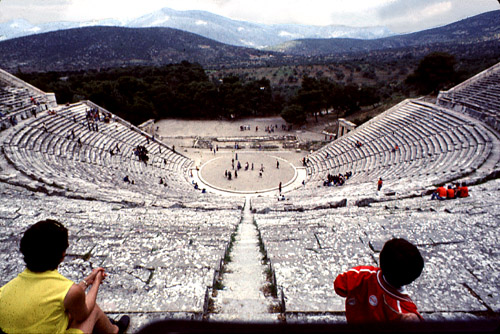
Located at the eastern end of the Peloponnese, 62 kilometres south of the Corinthian Canal, Epidaurus was an ancient healing as well as a cultural center.

Today its major draw is the almost perfectly preserved Amphitheatre.

The view, aesthetics, and acoustics of the theater are breathtaking. Its awe-inspiring acoustics are built with mathematical precision for the 14,000-seat theatre, 2,500 years ago. If you drop a matchstick in the centre of the original beaten earth stage it can be heard by people sitting in the highest of the 55 tiers. Epidaurus Theatre is a World Heritage Site and is an incredible feat of Greek achievement. It was then used for musical and poetry contests and theatrical performances.

Today, it still continues to amaze and delight audiences with frequent plays, concerts, and festivals, the highlight being the Annual Hellenic Festival held in July and August. Tickets for it can be bought either at the site or at the Athens Festival box office in Stadiou, (the main street connecting Omonia and Syntagma squares Athens). You can purchase a ticket that includes transport to and from Athens which is approximately a two and a half hour bus ride. Watching a Greek Tragedy enacted on the ancient stage from the ancient limestone stone seat is an experience beyond words. It lifts your spirit to the time of the ancients and you share the space with them and live the Greece of antiquity.

The rest of the site requires a little research and imagination to be fully appreciated but the notable ruins include:

The Foundations of the Temple of Asclepius: Greek mythology states that Epidaurus was the birthplace of Asclepius, the god of healing and son of Apollo. The site became one of the most important centres of healing in the ancient world and by the 4th century BC the cult was well established and the sick travelled from far to seek medical and mystical cures at the sanctuary dedicated to Asclepius. Alongside the Temple of Asclepius are the remains of the "Abaton" where patients slept in the hope of receiving a miraculous cure. Another structures, associated with healing is the bee-hive shaped "Tholos" that was once a snake-ridden labyrinth. Mentally ill patients had to crawl through it in darkness in the hope that the shock would bring them into good health!

Sanctuary of Egyptian gods

Sports Stadium

Odeon

Bath Complex

Museum: It displays ancient surgical tools, intricately carved reliefs from the Tholos and stone inscriptions detailing miraculous cures that supposedly took place at the sacred site

For more information visit:
http://www.greeklandscapes.com/greece/epidaurus.html; http://en.wikipedia.org/wiki/Epidaurus; http://www.greatbuildings.com/buildings/Theater_at_Epidauros.html (pictures)

How to Reach:
From Athens by Car: It is on the coach day trip circuit for tourists from Athens. However you can also drive down. Follow the signs to the "Ancient Theater of Epidaurus" which appears at regular internals after Corinth. They assure that you are on the right path because for a couple of hours it seems like a road to nowhere with no sign of life or gas stations.

From Nauplion by Car: Getting to Epidaurus from Nauplion is easier as the road is wider and the gas stations more frequent. Bus tours are also available from here.

By Bus: During festivals, there are also four or five buses that connect Nauplion to Epidaurus’ theatre. The only detail that should be kept in mind is to take only those with the sign indicating the theatre of Epidaurus, instead of those which sign says ‘Nea Epidavros’ or ‘Archea Epidavros’. Late at night, once the play ends, there is also a service to Nauplion making visitors’ return easier.

It is also on the tour bus circuit hence a lot of options are available from Athens and Nauplion

Medieval Enchanting Nafplion - Peloponnese, Greece

Old Nafplion, the former capital of Greece is very reminiscent of Plaka with its name-alike Syntagma Square. Though it is on a much grander scale, the atmosphere is very much the same with its melange of historical buildings, automobile free streets filled with casually strolling people, tourist shops, cafes, bars and restaurants. The waterfront strewn with cafe-bars, fish tavernas is popular with sunset viewers.

With two mountains crowned by medieval fortresses overlooking the town, the small island fortress, the Bourtzi (built by the Venetians to protect the harbour from Pirates), and a beach that you can walk to in ten minutes, Nafplion is a delight and is only 2 hours drive away from Athens.
The Palamidi Fortress overlooking the city is actually three separate fortresses walled together. There are 999 steps leading up to the fortress but for the less energetic a taxi ride to the top or drive up can be a good option. But the excursion is well worth it for the spectacular view it offers of the city, the bay and eastern Peloponessos.

There are a number of important churches in Nafplion and even a mosque. The old town is made up of Venetian buildings and neoclassical mansions, while the new town is a concrete jungle.

There is a little train that cruises the city (reminded me of Montmartre, Paris).

Near the park are the three museums, the Archaeological, the War Museum and the Folklore, all worthy of a visit
If you have time it would be worthy to discover the Psaromahalas or fisherman's district with its unique shops filled with arts and crafts
Behind Acronapflia is a mountain covered in cactus and a spectacular view of the coast. There is a pedestrian road that goes around the Acropolis to the town beach on the other side. It is a good option for swimming as well as snorkelling. Two miles east there is a beach at Karathona, with its long stretch of sand and trees for shade.
Nafplion is a great place to visit especially in the off season when it is cool and the tourists are gone.
It is also convenient to the important ancient sites of Tiryns, Argos, Mycenae, Epidaurus, Nemea and Corinth. For more details visit Matt Barrett’s website: http://www.greecetravel.com/nafplio/index.html

How to Reach:
From Athens by Car: Take the National Road that goes south through Corinth and towards Tripoli. Take the Sterna exit and go east through Argos to Nafplion. The trip will take you about 2.5 hours.
From Athens airport Nafplion is roughly a 3 hours drive
From Pireas Port the drive along the bewitching coastline takes about 2-2.5 hours.

From Athens by Bus: There are several buses that leave daily for Nafplion from Athens. More information can be obtained at http://www.ktel.org/.
bus terminals.
Accommodation: If you prefer a hotel right on the beach staying in one of the other smaller towns (Astros, Tolon) along the coast can be a good option. From any of these places the entire Argolis peninsula, Mycenae, Epidavros, Argos and Corinth is accessible by local transportation, tours or rental car. The Argolis is known for its citrus fruits and there are stands all through the area where you can buy oranges, artichokes, wine and whatever else is in season.

Byzantine Mystra - Peloponnese, Greece

Little remains of ancient Sparta, but approximately 8 Kms west of it, in a lovely setting, high on the slopes of Mount Taiyetos, overlooking the city of Sparta and the fertile plain surrounding it is the fascinating 15th-century Byzantine ghost town of Mystra. The last stand of the imperial Paleologos family, Mystra has a ruined royal palace and superbly frescoed Byzantine Churches (Agios Demitrios, Odigitria, Pantanassa, Peribleptos and Evangelistria)

The castle on the top of the hill was founded in 1249 by the Frankish leader William II de Villeharduin. After 1262 it came under Byzantine control, and at the middle of the 14th century became the seat of the Despot of Moreas. In 1448 the last emperor of Byzantium, Constantine XI Palaeologos, was crowned at Mystras. In 1460 the hill was captured by the Turks and in 1464 Sigismondo Malatesta of Rimini managed to capture the city but not the castle. For a short period Mystras came under the control of the Venetians (1687-1715) but was again taken over by the Turks. It was one of the first castles of Greece to be liberated in 1821. The foundation of modern Sparta by king Otto in 1834 marked the end of the old town's life

How to Reach
If you are visiting Mystra stay in Sparta or Githeon (if you prefer coast) is an option. But since Mystra is about three hour drive from Athens it can be done as a day-trip with the option of exploring Corinth en-route.
From Athens by Car: Take the National Highway that links Athens to Corinth. After you pass the Corinth Channel, you take the Highway to Tripoli. From Tripoli, you go to Sparti. Note that the road to Sparti is not a highway but a rural road. From Sparta, you follow the signs to Mystras. The distance from Athens to Mystras is 230 km, while from Sparta is about 5 km. The whole trip takes about 3 hours and a half.

From Athens by Bus: There are KTEL coaches from Athens going to Sparti. They depart from the bus terminal located in 100, Kifisou St., and the trip takes about four hours. From Sparti, you take the bus or a taxi to Mystras, 5 km away.

Mystra in pictures: http://www.islandstrolling.com/mainland/peloponnes/english/mystra.htm

Ancient Sparta

Modern Sparta stands at the same site of ancient Sparta. Situated on the River Eurotas, 225 km from Athens, in the southern part of the Peloponnese, Sparta was the contemporary of other Classical Greek city-states such as Athens, Corinth and Thebes. It was generally referred by the ancient Greeks as Lakedaimon or Lakedaimonia. As per Greek mythology, Lakedaimon was a son of Zeus by the nymph Taygete. He was king of the country which he named after himself, naming the capital after his wife Sparta, the daughter of Eurotas. However historic and archaeological evidence suggests that Sparta was founded during and after the Mycenaean War, in which the Dorian Spartans crossed the Taygetus Mountains and took the territory of Messenia.


Outnumbered by the native population of Messenia the Spartans instituted a military oligarchy under which, the native population of Messenia was relegated to the status of agricultural slavery, or Helots. Above the Helots were the Perioikoi, the traders & merchants of Spartan society. Atop both were the Spartiate who could trace their lineage to the cities original Dorian occupants. They were required to compulsorily serve in the army, could vote and hence were allowed full political rights of the state. Dictated by the same political needs it had a military oligarchy and managed to keep its lineage of kings throughout its existence.

The hierarchy had the two kings (dual monarchy), a counsel of 28 nobles, and the assembly of the Spartiate (composed of Spartan males). The assembly was run democratically and could veto or approve the rulings of the counsel above it. However, beyond the counsel and the assembly, was the Ephorate, a group of five men who practically guided all aspects of Spartan life. Regardless of how odd such a political system may seem, Spartan culture flourished.

Spartans also differed from its classical counterparts from the importance women had in society. Spartan women were taught reading, writing and were expected to be able to protect themselves. A girl's education was equally as brutal as the men's. Many athletic events such as javelin, discus, foot races, and staged battles were held for both sexes. Though Spartan women were expected and driven to produce strong and healthy children their roles were not limited to marriage and procreation. Spartan women had many rights that other Greek women did not have. They could own and control their own property and could also take another husband if their first had been away at war for too long. A woman was expected in times of war to overtake her husband's property, and to guard it against invaders and revolts until her husband returned.

King Leonidas, 300 Spartans & The Battle Of Thermopylae:
Known almost exclusively for its military strength, Sparta rose to military prominence and was recognized as the overall leader of the combined Greek forces during the Greco-Persian Wars. The story of Leonidas, the fifth century Spartan military king whose stand against the invading Persian army at the pass of Thermopylae in central Greece is one of the enduring tales of Greek heroism, invoked throughout Western history as the epitome of bravery exhibited against overwhelming odds. After the Persian army of Xerxes invaded Greece, the Spartan army prepared to join the armies of the other Greek states and march to face the Persians. When a religious festival delayed the departure of the army, Leonidas bravely led a small force of Greeks, mostly his Spartan royal guard of 300 soldiers, but also Thespian and Thebans, against the much larger Persian army at the pass of Thermopylae (Pillars of Fire) in 480 B.C. There, Leonidas and his men held the pass for three days (their tight phalanx wall and discipline were no match for the Persians) and was defeated only after a Greek traitor revealed to the Persians the existence of a mountain trail that allowed them to outflank and attack the Greeks from the rear. All the Spartans and Thespians died, including Leonidas. However, those three days gave valuable time to the Greek armies to prepare for battle and later to defeat the Persians. However, by 362 BC Sparta's role as the dominant military power in Greece was over and today only ruins remain to sing the glory of the fierce valiant warriors who once dominated the region.

But Sparta still continues to fascinate us.
The main attractions from the excavations include:

The Acropolis: In contrast to other ancient Greek cities, Sparta was not a compact fortified city-state centre with monumental civic and religious buildings. It was a loose collection of smaller villages spaced over a large rural area and 6 low hills. The highest of these served as the site for the Acropolis.

Temple of Athena Chalkioikos: The Sanctuary of Athena Chalkioikos on top of the Acropolis lies north of the theatre. Ulysses is supposed to have installed the statue and called it Athena of the Road when he beat Penelope's lovers in the race. The Temple constructed on the plans of the architect Vathykles from Magnesia, had its interior decorated with bronze sheets and was one of the most important cult sites of the classical town.

In the Hellenistic period the Theatre, Stoa and Agora were built near the Acropolis, but the Temple of Athena and the earlier remains at the Sanctuary of Artemis Orthia on the West bank of the Eurotas river are almost the only archaeological remains from Archaic and Classical Sparta.
However no visit to Sparta is complete without a visit to the Archaeological Museum of Sparta and the unique Museum of the Olive and the Greek Olive Oil.
Other nearby sites includes the Archaeological Site of Pellana. Some views suggest that the Archaeological Site of Pellana is the Homeric Lakedaimon where Menelaus and Helen had their palace.

How to Reach
By Bus: From Athens KTEL coaches depart daily from the Bus Station for the Peloponnese, Odos Kifissou 100, for the Sparta bus station at Odos Lykourgou, a street also known as Odos Metropolitou Dafnou and Odos Eurotas. The trip takes about four hours.

By Car: it falls on the Corinth -Tripoli, or Patras route
From Athens by Car Take the National Highway that links Athens to Corinth. After you pass the Corinth Channel, you take the Highway to Tripoli. From Tripoli, you go to Sparti. Note that the road to Sparti is not a highway but a rural road. The distance from Athens to Sparta is about 225 km. The whole trip takes about 3 hours and a half.

Homeric Mycenae, The Land of Agamemnon - Peloponnese, Greece

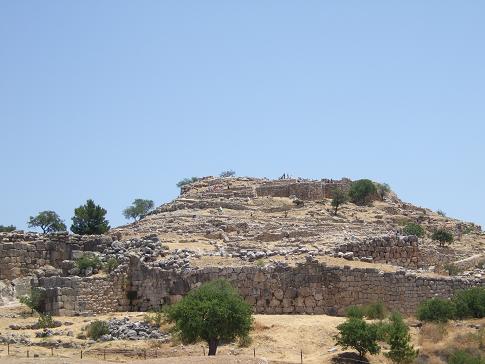
The ruins of an ancient city state of Mycenae enae, located in the North-East part of Peloponnese in Argolis, (about 1.5 hours away from Athens), dates back to the second millennium B.C. Situated on top of a rocky hill high above the modern town, it is an imposing site. In its days of power it equalled its other city state contemporaries such as Athens, Corinth, and Sparta in its pursuit of art, wealth and military might. The riches and artefacts uncovered in the various sites are now on display in the National Archaeological Museum of Athens and Mycenae. At one point the Mycenaean’s controlled the island of Crete. The term "Mycenaean," applies to an entire culture spanning the years 1700-1100 BC.

Legend & Myth
Legend has it that Mycenae was founded by Perseus and its most famous king immortalized in Greek epics is Agamemnon. As per versions drawn from epics and legends Agamemnon were married to Clytemnestra and his brother Menelaus, who was also the king of Sparta was married to the beautiful Helen. Aphrodite the Goddess of Beauty and Love offered Helen to a Trojan prince, Paris and Helen some what willingly went with Paris to Troy. This enraged the brothers and Agamemnon built a war contingent of some of the best warriors, and set sail to Troy to bring back Helen. This resulted in the Trojan War which lasted for ten years and is best described in The Iliad by Homer. During these ten years, Clytemnestra finds a lover, Aigisthos. They drive Agamemnon's son Orestes and his daughter, Electra, into exile and rule Mycenae together. Upon Agamemnon's return, they murder him in his bath with an axe. After ten more years Orestes finds him self at the Temple of Apollo at Delphi. Apollo asks Orestes to avenge his father’s death by slaying his mother and her lover. So he returns to Mycenae and kills both, Clytemnestra and Aigisthos. This act rises up The Furies from the Earth and they try to take vengeance for killing ones mother was a serious crime. The Furies chase Orestes to Delphi where Apollo tells Orestes to go to Athens and ask for Athena, The Patron Goddesses forgiveness. He goes to Athens where he seeks shelter in the temple of Athena and begs for forgiveness. He is put on trial by the Athenians in front of the Areopagus. The jury results in a tie and Athena casts the final vote which declares him not guilty. This was the first instance of a jury trial. Athena then asks the Furies to spare the city from their wrath and the furies agree. (The Libation Barriers, Eumnides). This is just a compilation of the myths and legends that surround Mycenae.
These events may have happened and later were immortalized by poets in their epics. The city exists and a large number of people visit it every year, drawn by the power of legends and history.

The most interesting ruins that still remain are:
Acropolis: All that remains today of the acropolis are the building foundations, and the immense wall that crowns the top of the hill. It sits atop an impressive mountain and is flanked on either side by taller mountains forming a very formidable fortification for the site. Only the ruling class inhabited the hilltop palace, with artisans and merchants living just outside the city walls. It was abandoned in 1100 BC after a period of great disruption in the region

Lion Gates: It is the earliest known piece of monumental sculpture in the European continent. Through this you enter the Acropolis.
The Palace: The Palace was built on the summit and along massive terraces on the south-western and eastern slopes of the hill. The official entrance was via an H-shaped Propylon. The current main approach to the palace is through the Great Ramp which begins at the back end, just beyond the Lion Gate.

Grave Circle A: Circle A is very similar in layout to Circle B but was used slightly later. It is located just inside the Lion Gate, but only after the extension of the ramparts in the 13th century BC, before that it was outside the walls. Useful links: http://www.odysseyadventures.ca/articles/mycenae/mycenae_circle-a_plan; http://www.odysseyadventures.ca/articles/mycenae/mycenae_circle-a_objects; http://www.odysseyadventures.ca/articles/mycenae/mycenae_circle-a_jewellery.htm

Grave Circle B: beyond the fortification walls were the graves of the earliest kings of Mycenae and their families, enclosed by a low circular wall. The circle partly underlay a later Tholos Tomb, known as the Tomb of Clytemnestra, and was discovered in the course of restoration work to it in 1951. Useful links: http://www.odysseyadventures.ca/mycenae_circle-b_plan

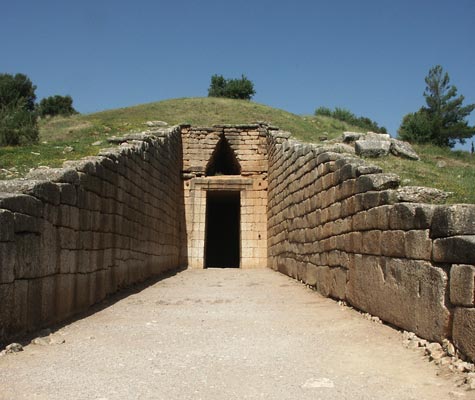
Treasury of Atreus: It is a beautiful Tholos Tomb built around 1250 BC, also known as ‘Tomb of Agamemnon’. The size of the tomb and the masonry work is awe inspiring. Despite its name, no treasures were found in the tomb as it was pillaged in ancient times. It is situated on another hill opposite the palace just beyond the general parking lot and is easily accessible from the road. You can enter by showing the ticket you bought at Mycenae. Useful links: http://www.odysseyadventures.ca/articles/mycenae/mycenae_atreus-plan.htm
Though many of the artefacts that were unearthed at Mycenae have been taken and are currently exhibited at the National Archaeological Museum, Athens, the National Archaeological Museum of Mycenae is also full of important artefacts and definitely worth a visit.

Important Information
Mycenae is a challenging site to navigate. There is a steep climb through the ruins with rocky paths and practically no respite from the burning sun. Hence dress lightly, wear steady, comfortable shoes, carry a sun hat, eyeshades, sun-screen lotion and bottled water.
The excursion may vary between 1 – 2 hrs depending on your pace. Remember once you pass the ticket booth there is no place to buy water or toilet facilities. Hence first go near the museum before entering the Lion Gates. However, it would be best to climb the ancient ruins first and save the museum visit for the hotter part of the day.

Enter the site through the Lion Gate and follow the well marked path up the hill, past the palace, all the way to the Northern Gate. If you wish to descent down to the underground cistern carry a flash light since the tunnel is completely dark, steep, and slippery.

By 10:00 AM quite a number of tourist buses arrive resulting in full parking lots, long lines at the ticket counter, and a site that is difficult to navigate. Hence it’s best to reach early and finish the ruins before the arrival of the tourist buses and the sun becomes scorching. But if you are coming by one of the tour buses choose one that reaches the earliest.
How to Reach
From Athens by Car: Driving from athens you take the national road that goes south through Corinth and towards Tripoli. Take the Sterna exit and go east through Argos to Mycenae. The trip will take you about 2 hours.

From Athens airport Mycenae is roughly a 2.5 hours drive
From Pireas Port the drive along the bewitching coastline takes about 2-2.5 hours. http://books.google.com/books?id=5hdsVl8cBgwC&pg=PA508&lpg=PA508&dq=How+to+Reach+Mycenae&source=bl&ots=xoaVrjF6JA&sig=9k7dz1B5JZmXmizb0WYR8GZwQAc&hl=en&ei=_rLQScbgKaCUjAfz0ojfBA&sa=X&oi=book_result&resnum=7&ct=result
From Athens by Bus: There are several buses that leave daily for Mycenae from Athens. More information can be obtained at http://www.ktel.org/. Moreover, many buses ply from Athens to Mycenae from the KTEL long distance bus terminals.
It is also on the tour bus circuit hence a lot of options are available from Athens and Nauplion

Monday, 28 September 2009

Ancient Corinth and the Canal - (Peloponnese)

It is an ancient city about 48 miles west of Athens on the Isthmus of Corinth, the narrow strip of land that separates the Peloponnese from northern Greece. In ancient times it was a leading naval power as well as a rich commercial city and controlled the stone-paved roadway that connected the Saronic Gulf with the Gulf of Corinth.
The tradition of celebrating the Isthmian Games in honour of the sea god Poseidon started in 582 BC and at the Isthmian Games of 336 BC, the Greeks chose Alexander the Great to lead them in war against the Persians. It was partially destroyed by the Romans in 146 BC, but in 44 BC it was rebuilt under Julius Caesar. Roman Corinth prospered and was the capital of Roman Greece. The Apostle Paul visited Corinth in the 50s AD and later wrote two letters to the Christian community at Corinth (the books of 1 and 2 Corinthians in the New Testament). The invasion of the Herulians In 267 AD, initiated the decline and Alaric's invasion in 395–396, destroyed Corinth. After 1204, when Constantinople fell to the Fourth Crusade, Corinth was captured by the Turks in 1458; the Knights of Malta in 1612; the Venetians from 1687 till 1715 which marked the return of the Turks. The city finally came into Greek hands in 1822.

Systematic archaeological excavations of the area have brought to several monuments. The finds are exhibited in the on-site Archaeological Museum of Ancient Corinth.
After a severe earthquake Corinth was moved in 1858 from the site of ancient Corinth to its present position, where it was again rebuilt after a further earthquake in 1928 and a great fire in 1933. Like ancient times, today’s Corinth is the centre of commerce between northern and southern Greece and is the second largest city in the Peloponnese with several sites of historical & religious interest.

Attractions: Much of the city has been toppled by recurring earthquakes over the centuries and of what remains most of the buildings are Roman, a testimony to Julius Caesar’s rebuilding. Areas of interest include:

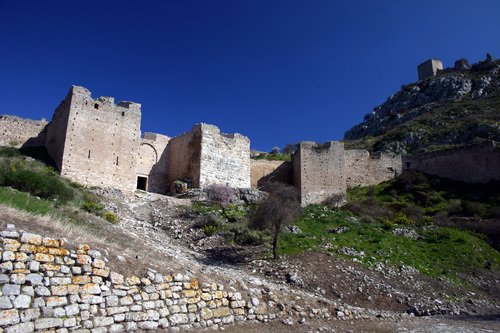
Acrocorinth –A superb natural acropolis, Acrocorinth was first fortified by the ancient Greeks. Everyone who came later -- the Byzantines, Franks, Venetians, and Turks -- simply added to the original walls. Today, there are three courses of outer walls; massive gates with towers; and a jumble of ruined houses, churches, and barracks. It is a short drive from the current city of Corinth.

On the Acrocorinth itself are ruins of the Temple of Aphrodite. The Temple of Aphrodite had more than 1,000 sacred prostitutes at one time, exemplifying the ancient city's reputation for luxury and vice. Also on Acrocorinth are the ruins of a stone minaret and ancient defensive walls.

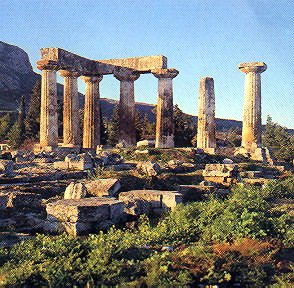
Temple of Apollo - one of the oldest stone temples in Greece, it is one of ancient Coronith’s most notable ruin. Built in 6th-century BC, today seven of the original 38 Doric columns still stand, on a hill that overlooks the extensive remains of the Roman Agora. Historical evidence points to the functioning of the temple even in the time of Apostle Paul (50s AD) but was eventually destroyed by earthquakes.

Temple of Octavia – dedicated to the sister of Emperor Augustus 27 BC-14 AD it represents the imperial cult of Rome, which was spread throughout the empire. Today very little of the ruins remain

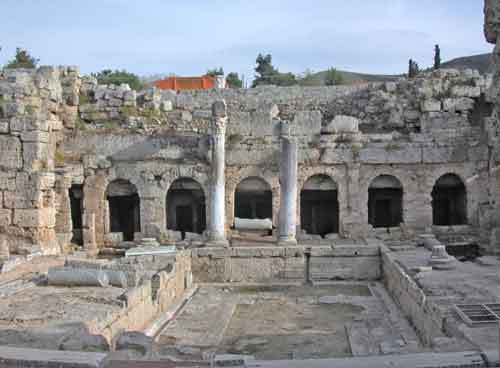
Sacred spring – it is located along the northern edge of the forum and was above ground in the 5th century BC but later building activities covered it. A secret passage near the sacred spring leads to a small shrine. The passage was might have been used by the priests.

Bema - Within the Roman Forum it is the public platform from where St. Paul had to plead his case when the Corinthians hauled him up in front of the Roman governor Gallio in 52 AD.

Peirene Fountain – it was the major source of water for Corinth. Significant ruins of it can still be seen today in the Roman Forum. Frescoes of swimming fish from a 2nd-century addition and a niche in the wall probably containing a statue can still be seen. The fountain is named after the legend of Peirene, a woman who wept so hard when she lost her son that she finally dissolved into the spring that still flows here.
Asklepieion – The sanctuary of the god of healing with a small temple (4th century BC) is located north of the theater, inside the city wall. It is set in a colonnaded courtyard with a series of dining rooms in a second courtyard. Terra-cotta votive offerings representing afflicted body parts (hands, legs, breasts, genitals, and so on) were found in the excavation of the Asklepieion, many of which are displayed at the museum.

The Archaeological Museum of Ancient Corinth – it contains a number of artefacts of religious interest, including inscriptions of Gallio and Erastus, both mentioned in the Book of Acts; a synagogue inscription, menorah reliefs, and votive offerings of terracotta body parts to Asklepios.

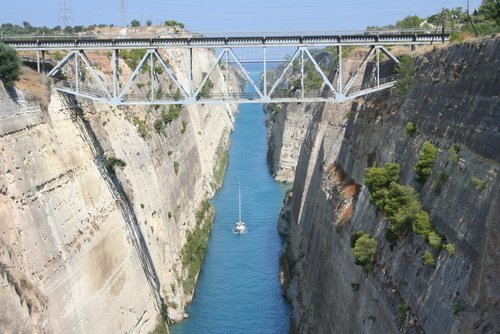
Coronith Canal - A canal through the Isthmus of Corinth was begun under the emperor Nero in 67 AD., but not completed. Up to the 12th century, ships were dragged on rollers across the isthmus. The modern attempt at construction began in the 1870's following the successful opening of the Suez Canal The 4-mile (6-km) Corinth Canal was finally completed in 1893, providing an essential shipping route between the Ionian and Aegean seas.

The Corinth Canal is considered a great technical achievement for its time. It saves the 400 kms long journey around the Peloponnesus for smaller ships, but since it is only 21 meters wide it is too narrow for modern ocean freighters. The canal is nowadays mostly used by tourist ships; 11,000 ships per year travel through the waterway. It is interesting to see the bridge across the east entrance to the canal which submerges for boats to cross over it. Useful Links: http://www.corinthcanal.com/
A nice place to stop for a coffee is the Perama Restaurant-Cafe and if you are lucky a ship will pass and you can watch the bridge go down.
How to Reach: You can get to Corinth by car, coach or train. The route by the train is majestic as it passes through all the coastal villages offering a wonderful view and an enthusing landscape succession. The suburban railway line {proastiakos}from Athens Airport is the best way to reach Corinth in 90 mins direct from the airport.
Practical Information:
CORINTH(area code: +30 27410)
Municipality: 24-518
First Aid: 25-711
Port Authority: 28-888
Police Department: 22-143
Tourist Police: 23-282
Traffic Police: 23-333

Discovering the Peloponnese - Greece

Once you have experienced the wonders of Athens/Attica and want to continue your Greek Odessey, heading towards the Peloponnese can be a wonderful idea. The area of Peloponnese is one of the most beautiful regions in the country & hides amazing scenery & spectacular ruins. It offers 'archeological landmarks' as well as "off the beaten track" holiday options.

There are peaceful and secluded areas all over the region, which makes a perfect destination away from the hustle and bustle of places such as Athens or other popular Greek Islands. With the bluest blue seas, breathtaking landscapes and pearls of villages, Peloponnese is like living a Greek dream.

The Peloponnese (Peloponnesus) is the southernmost peninsula of Greece and technically has been an island since the Corinth canal was opened in 1893.
I have included some of the wonderful destinations in Peloponnese and have classified them as POAI (Point of Archeological Interest) or POB (Point of Beauty). Sometimes both go hand in hand and hence would be classified as POAI & POB. A couple of them like Ancient Corinth & Epidaurus can be discovered as an day excursion from Athens. There are numerous agencies offering day packages. You can also drive down.

For more details check my other blogs. You can use the search option available on the home page.

Destinations:
  • Ancient Corinth and the Canal - POAI

  • Medieval Naphlion - POAI & POB

  • Epidaurus, the Ancient Stage (Amphitheatre) - POAI

  • Homeric Mycenae, The Land of Agamemnon - POAI

  • Ancient Sparta - POAI

  • Byzantine Mystra - POAI & POB

  • Mecca of Olympics, Ancient Olympia - POAI

  • Kalavrita, (A journey through Vouraikos Gorge, The Cave of the Lakes, Ski Tracks & Greek War Monuments) -POB & POAI

  • Lousios Gorge, Hikes and Monasteries: POB & POAI

  • The Beaches of Koroni & Methoni: POB

  • Elafonissos - POB

  • Methana, A Volcanic Excursion: Point of Geological Interest