Showing posts with label Hills of Historical Interest. Show all posts

Thursday, 1 October 2009

The Best of Epirus Region, Greece (Vikos Gorge & Zagoria, Metsovo, Ioannina, Dodoni, Nekromanteion


Epirus has the strongest regional identity in mainland Greece, bordering the peripheries of West Macedonia and Thessaly to the east, Central Greece to the south, the Ionian Sea and the Ionian Islands to the west and Albania to the north.

It owes its character to an unrelenting mountainous terrain (Pindus Range), forested gorges & wild rivers. These natural fortifications have been successful in protecting and isolating the region from outside interventions, even to a great extent from the Ottoman Rule. Their roles in ancient Greek affairs were relatively insignificant with only four archaeological sites of any importance, out of which two are isolated Oracles. But the regions attraction lies in its sheer physical beauty with limestone peaks and dense forests which provides an enchanting background to traditional stone built villages and arched packhorse bridges. Areas of interest in this region of Greece would include

Nature Trails

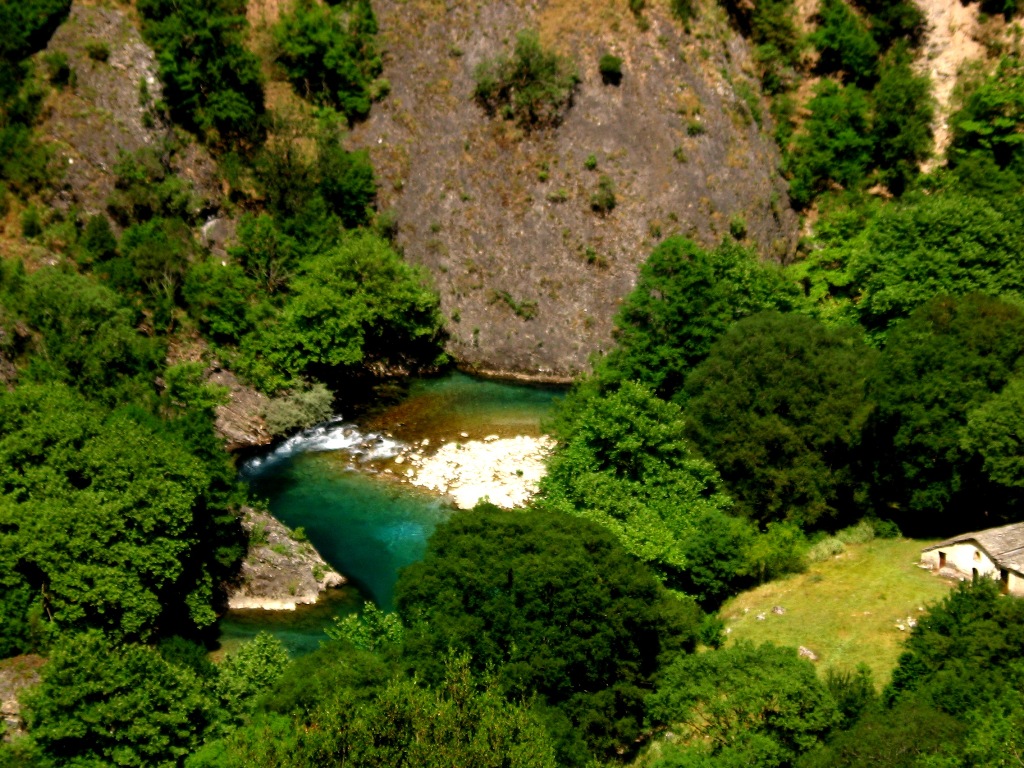
  • Vikos Gorge & Zagoria - The deepest gorge in the world by the Guinness Book of Records, it offers a landscape of awesome beauty, as the walls of the canyon reach at some points the height of 1 kilometre and the crystal clear waters of Voidomatis River run through it in a spectacular route.
  • Up on the mountains of Pindus some 45 picturesque villages called Zagoria or Zagorohoria offer unforgettable images to the visitor: traditional architecture and a unique folkloric character, countless centuries-old bridges and water fountains, cobble-stone meandering streets and passages, stone-built churches and tiny chapels and Mount Tymfi with its highest peak Gamila & Smolikas for the serious and seasoned trekkers.
  • Metsovo (County of Ioannina) - an easily accessible charming village and should be visited if you want to savour the taste of Greek mountain life

Archaeological & Historic Interests

  • Archaeological site of Dodoni Oracle - The oldest Hellenic oracle, dedicated to Zeus and the Mother Goddess. The site also includes an amphitheatre dating to the 3rd century BC.
    Lakeside town of Ioannina - It is the historical, cultural and commercial hub of the Epirus region. It was the capital of the tyrant Ali Pasha. The old town is strewn by the remains of the Ottoman quarters (the mosque, old fortifications) Ottoman-flavored bazaar and inexpensive eateries rimming the lake.

Ancient Nekromanteion, Oracle of the Dead (County of Preveza) - Located on a cliff near the shores of the lake Acherousia, at the junction of the rivers Kokytos and Acheron. According to the ancient Greek mythology, the Acheron river (‘river of woe’) was a branch of the underworld river Styx over which Charon ferried the newly dead souls across into Hades. So it is here, at the Nekromanteion, that the ancients believed were the Gates to the Dead. (Spooky)

Monday, 14 September 2009

Athens & the Hills - Areopagus (Mars Hill); Filopappou (Hill of Muses); Pnyx (Hill of Pnyx)

The Hills of Athens
Most visitors to Acropolis of Athens arrive and leave by the same route through the Plaka. For a increasingly panaromic option its worth taking the time to explore the area to the west of the Acropolis dominated by the Hills.
Areopagus (Mars Hill)
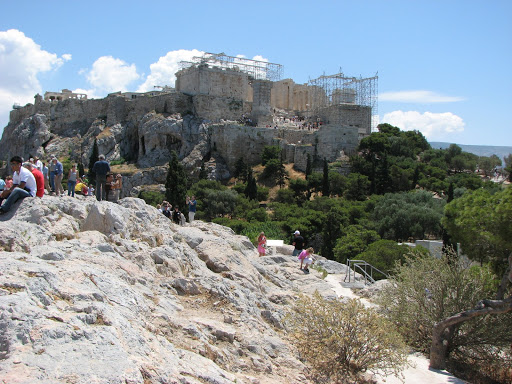
It is a historic hunk of rock found near the entrance to the Acropolis, just above the site of the Ancient Agora. Ares was supposed to have been tried here by the Gods for the murder of Poseidon's son Alirrothios. Aeschylus used this setting in ‘The Eumenides’ for the trial of Orestes who pursued by ‘the Furies’ demand of ‘a life for a life’ for killing his stepmother Clytemnestra and her lover Aegisthus. This served as the site of the homicide court and was the meeting ground of the elders in Ancient Athens. It was used as a campsite by the Persians during their seige of Athens. In the Roman era it was used by Saint Paul who preached the ‘sermon of an unknown God’ from here. Amognst his many converts was Dionysius who later became the patron saint of the city.
For more information click on: http://www.destination360.com/europe/greece/areopagus-hill.php

Filopappou (Hill of Muses)
The "Hill of the Muses", as it was known in ancient times, is situated within walking distance of Old Athens and offers some of the finest views of Athens (from the Saronic Gulf to the Argolic Hills. Its summit is capped by a monument to a Roman Senator. Northwest along the main path is church Ayios Dhimitrios and in the cliff-face across to the south there is a kind of cave dwelling known as the Prison of Socrates. It also shares some negative history. The shell that destroyed the roof of the Parthenon was lobbed from here. In 1967 during the coup, tanks were placed by the military on its slopes and in recent times this place is best avoided at night as there have been quite a few instances of crime. For more information click on: http://www.athensinfoguide.com/wtsphilopappou.htm

Pnyx (Hill of Pnyx)
To the west of the Acropolis, the Pnyx is a rocky hill surrounded by parks. In ancient Athens this was used as the site for the gathering of the Democratic Assembly. It was literally the cradle of democracy, the Athenians used to gather here to discuss political issues and to take decisions on the future of their town. Later with the growth of Athens the Assembly was shifted to the Theatre of Dionysos. Apart from the platform of the Pnyx, other ancient remains include two large stoas, built to shelter people in case of bad weather, the altar of Zeus Agoraios and the sanctuary of Zeus Hypsistos. Beyond the Pnyx lies ‘Hill of Nymphs’ dominated by an observatory & gardens. For more information click on: http://en.wikipedia.org/wiki/Pnyx